Hostilities in Ukraine represent a completely new type of conflict, in which many old combat practices, proved to be efficient in previous conflicts, have either ceased to work altogether or have become dramatically less effective
Despite the triumphant reports from the Russian General Staff and war correspondents regarding the Ukrainian conflict, in recent months there has been an active expansion of the geography of Ukrainian strikes — the focus has shifted from the border regions of Belgorod, Kursk, and Bryansk deeper into the country. Oil refineries and oil export infrastructure suffer most from the attacks. The list of targeted strikes on civilian targets grows almost daily. Russia’s adversary has long since switched to the tactic of terrorizing the civilian population and causing damage to non-military infrastructure.
According to Western media, 16 Russian oil refineries have already been attacked in 2026. As a result, almost all major oil refineries in Central Russia have suspended or reduced fuel production. So far, according to authorities’ assurances, there is no fuel shortage in the country. Which is good news, since the agricultural season has already entered its active phase.
However, the overall trend raises certain concerns.
In attempts to economically weaken Russia, Ukraine is striking at the hydrocarbon export infrastructure in ports. The idea behind is clear: to prevent Russia from fully benefiting from the rise in oil prices caused by the blockade of the Strait of Hormuz.
Ukrainian strikes are mainly concentrated on two directions.
On the Black Sea are the ports of Novorossiysk, Tuapse, and Taman. About 20% of maritime oil exports go through Novorossiysk. The Sheskharis terminal and the facilities of the Caspian Pipeline Consortium are located there. Tuapse hosts the only oil refinery on the Black Sea coast and an oil terminal. The Tamanneftegaz terminal and a reservoir park for storing petroleum products and liquefied gas with a total volume of more than 1 million cubic meters are located in Taman.
The second direction is the Baltic. The main targets here are the ports of Primorsk and Ust-Luga in Leningrad Region. They account for about 40% of all Russian oil exports. (Also, in addition to drone attacks, NATO’s northern countries threaten to block the shipping of the so-called shadow fleet in the Baltic, which will also over time contribute to a reduction in export volumes. However, the main goal of such provocations is to force Russia to open a second front and divert forces from the main Ukrainian direction.)
Each of the ports in these two directions has experienced several major Ukrainian UAV raids this spring. And while the ports of the Krasnodar Kray are relatively close to Ukraine, getting to the Baltic coast is a challenge. Sending drones on a long journey through Bryansk, Smolensk, Tver, and Novgorod Regions runs a high risk of losing them en route due to Russian air defense.
A different matter is the “brotherly” countries to Ukraine — Poland and the “Baltic tigers.” The flight distance is almost the same, but drones fly unhindered all the way to the Russian border. True, some drones sometimes spontaneously fall before reaching Russia, causing concern among local authorities. Even greater concern was caused by Moscow’s reaction to the fact that Ukraine is using the airspace of NATO countries for attacks on Russian territory.
After a public warning that such Baltic “hospitality” would provoke a corresponding response from Russia, the Balts very insistently asked Kiev not to repeat such experiments with drones flying through their territory. One can only guess what specific consequences Russia promised the “extincting” Baltic states at the unofficial level. But in any case, it worked. The other day, NATO fighters patrolling the skies of Estonia shot down a Ukrainian drone flying through the country’s territory for the first time since the beginning of hostilities between Russia and Ukraine.
However, the main bet of the Kiev regime is not to undermine Russia’s military-economic potential with small bites, but to provoke internal instability. They themselves have publicly stated this many times. Constant drone attacks, including on civilian objects, are needed to create a psychological effect favorable to the adversary.
Within the framework of this strategy, a major raid on Moscow Region was undertaken on May 17. Within 24 hours, more than 120 Ukrainian drones were shot down over the region. As a result of the raid, 3 people died in Moscow and the region, and 18 were injured.
The mockingly worded inscriptions on the downed drones leave no doubt that the main task of the drone attack was not to destroy industrial potential, but to terrorize the civilian population.
The Ukrainian side claims that by striking Moscow, they are trying to break the media concept of the Special Military Operation as a limited military operation taking place on the outskirts of the country and not affecting the majority of the population. And thereby, they hope to provoke dissatisfaction among the Russian citizens directed against the authorities.
It is also important to note that on the eve of this daring attack, two media-significant events occurred.
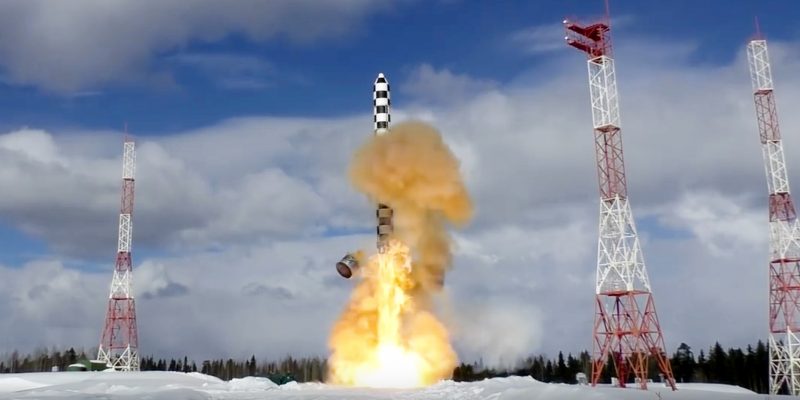
On May 12, Commander of the Strategic Rocket Forces Sergey Karakayev reported to Putin on the successful test launch of the newest intercontinental ballistic missile Sarmat. Putin, in turn, announced that the Russian Armed Forces would adopt the Sarmat missile system at the end of 2026. The signal to Russia’s “western partners” is quite clear.
The next day, May 13, the Moscow Anti-Terrorist Commission imposed a ban on the distribution of textual, photo, and video materials showing the consequences of UAV attacks in the capital. Previously, similar bans were introduced in other regions, but Moscow is a special region, with the most powerful air defense umbrella in the entire country, for obvious reasons.
Whether the Moscow and/or federal authorities knew about the impending attack or not is a separate question, clearly not for public discussion in wartime conditions.
But the fact that in the information-psychological confrontation, the attack of May 17 was a well-calculated response (and, in essence, a provocation to escalate) is obvious to everyone.
Hostilities in Ukraine represent a completely new type of conflict, in which many old combat practices, proved to be efficient in previous conflicts, have either ceased to work altogether or have become dramatically less effective. In this new war, victory goes not to the one with more/better tanks, artillery, planes, or drones, but to the one who reacts faster and more flexibly to changing situations, introduces innovations, masters technologies, and does not stifle the initiative of those on the ground. The one who does not lose touch with reality, hiding behind anything — television, a refrigerator, or optimistic reports.
This is a translation of an excerpt from the Oh, did I miss out on something? article by Maksim Karev, Dmitry Vetchinkin, Olga Levandovskaya, first publised in The Essence of Time newspaper, issue 671.