Considering that in the US itself, not every US citizen owns a store, a café, or even their own home, and several tens of millions of people live on benefits and receive food stamps to keep from starving, it follows from Rubio’s logic that the main obstacle for needy US citizens is the US government and US fat cats. And that is indeed true.
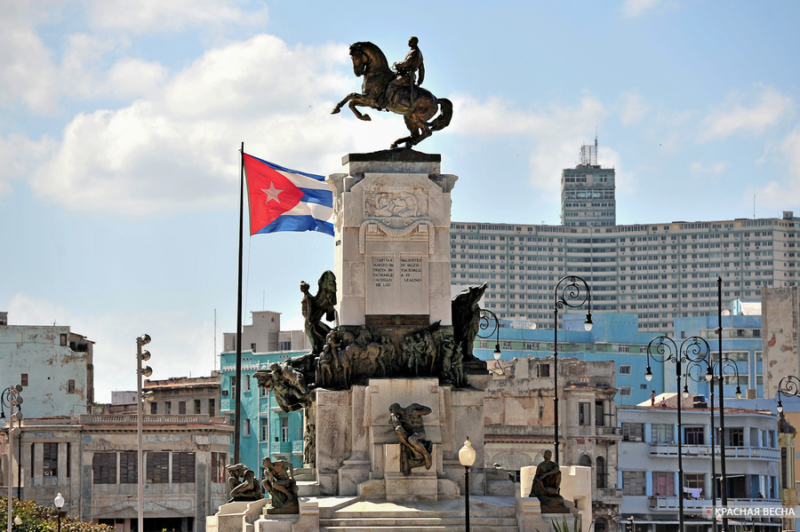
The Iranian conflict is currently in a low-intensity phase and, apparently, will remain so in the near future. The visit of the US delegation led by Donald Trump to China cannot be called a breakthrough either, so now the White House administration is intensifying its efforts in its own backyard — in Latin America. The tip of the US spear is now aimed at Cuba. For now, the Island of Freedom looks like the most promising target for boosting the Republican Party’s ratings in the upcoming congressional elections.
Pressure on the Cubans is twofold — on the one hand, the naval economic blockade, which has already led to massive and prolonged blackouts, and on the other, psychological pressure through military and diplomatic means. Let us reiterate: a purely military solution to the “Cuban question” is the least preferable option for the Trump administration, while repeating the “Venezuelan” scenario is, on the contrary, the most advantageous in media terms. Its only, but extremely important, drawback is the extremely limited timeframe within under which Trump is forced to act. Therefore, even the muscle-flexing staged by the USA in the Caribbean Sea in recent days is more a form of psychological warfare than real preparation for a ground operation.
Meanwhile, the share of Latin Americans in the US who support Republicans is rapidly shrinking, which forces Trump and his team to accelerate the situation.
In mid-May, the American publication Politico wrote that, contrary to White House expectations, the Cubans turned out to be much stronger, and US attempts to force them to carry out reforms in favor of the US have, by and large, failed. And now the White House is considering various options for a military solution. According to sources of the publication, the Department of War, headed by Pete Hegseth, is considering the full spectrum of possible solutions — from a single deterrent airstrike to a full-scale ground invasion followed by regime change.
But since the majority of US citizens of non-Cuban origin are much more concerned about rising fuel and other commodity prices caused by the campaign against Iran, the White House is trying to convince its own population that Cuba poses a real threat to them. According to US intelligence data published by Axios, Cuba has acquired more than 300 military drones and is allegedly preparing plans to use them to attack the US military base at Guantanamo Bay, US warships, and even possibly the Florida town of Key West, 150 km from Havana.
Naturally, the “hand of Moscow” was also mentioned. According to US officials, Cuba began purchasing strike UAVs from Russia and Iran starting in 2023 and has hidden them all over the island. In addition, intelligence notes, Russia and China have an electronic warfare center in Cuba.
It is obvious that this data could be used as a pretext for war, even if no UAVs exist.
Interestingly, on May 14, CIA Director John Ratcliffe himself visited Cuba and warned Cuba against participating in military actions. Ratcliffe warned that Cuba can no longer serve as a staging ground for US adversaries to advance hostile plans.
On May 20, the US Department of Justice released an indictment against 94-year-old Raúl Castro for allegedly ordering the shooting down in 1996 of two aircraft operated by the Miami-based humanitarian organization “Brothers to the Rescue.” At the time, Raúl Castro was Cuba’s Minister of Defense. As a result of the incident, 4 crew members died. The Cuban command claimed that the aircraft pilots were repeatedly warned about violating the island’s airspace and were shot down only after that.
Interestingly, the George Washington University (organization recognized as undesirable in Russia) project, the National Security Archive, recently published declassified documents on this incident. According to them, officials in the administration of President Bill Clinton repeatedly warned at the time that the actions of the human rights activists were provocative, violated Cuba’s sovereignty, and that Havana would sooner or later use force. Which, in fact, it did.
Now, with this 30-year-old incident, the US Justice Department under Trump is trying to pressure Castro, reminding him that the punishment under this article provides for the death penalty or life imprisonment. Moreover, the acting US Attorney General Todd Blanche, who heads the Justice Department, stated that Raúl Castro will appear before a US court voluntarily or otherwise. A very transparent hint at the fate of Venezuelan President Maduro.
By the way, The New York Times previously wrote, citing sources, that the US does not rule out conducting an operation to capture Raúl Castro.
However, one important point is worth to mention. Cuba is not Venezuela, where, as everyone now understands, Maduro was betrayed by his own entourage. And it is worth remembering that during the capture of Maduro, all his Cuban bodyguards were killed, unlike the Venezuelan ones, who fled in fear of the US “wunderwaffe”.
In Cuba, instructions have begun to be distributed among the population in case of “hostile strikes.” They recommend assembling an emergency kit for three days, keeping documents, water, medicine, a radio, a flashlight, and toys for children on hand.
The date of the indictment against Raúl Castro — May 20 — is also an element of psychological warfare. On May 20, 1902, Cuba, with the help of the USA, freed itself from Spanish rule and declared independence. However, for a long time thereafter, the island remained de facto a US protectorate. Therefore, Independence Day in Cuba is celebrated on October 10 — the day the war against Spanish rule began in 1868.
Nevertheless, on May 20, Secretary Rubio’s Message to the Cuban People on Their Independence Day was released, in which he explained the true causes of the suffering of the Cuban people. (Recall that Rubio is the son of Cuban emigrants who left the island for the US long before the Castro brothers came to power there). So, according to Rubio’s version, the lack of electricity 22 hours a day, fuel, and food happened because the Cuban authorities “have plundered billions of dollars, but nothing has been used to help the people,” and not because the US is strangling the island with sanctions.
In his address, Rubio also spoke of a beautiful future Cuba, where ordinary Cubans can own a gas station, store, or restaurant, and can even open their own bank or construction company, create a television company or other media. In the end, Rubio effectively called on Cubans to change the regime, stating, “The only thing standing in the way of a better future are those who control your country.”
Considering that in the US itself, not every US citizen owns a store, a café, or even their own home, and several tens of millions of people live on benefits and receive food stamps to keep from starving, it follows from Rubio’s logic that the main obstacle for needy US citizens is the US government and US oligarchs. And that is indeed true.
Last but not least, recent news is to mention: Canada’s Sherritt, which jointly with Cubans develops cobalt deposits on the island, reported that it has preliminarily agreed with US Gillon Capital to sell it 55% of its shares. In other words, all the economic pressure the US is exerting on Cuba is for the greater benefit of US imperialism itself, and not at all for the Cuban people. And yes, the US entrepreneur Ray Washburne and his family, who own Gillon Capital, just happen to be in Trump’s inner circle. Even here, the “diamond” president has found a way to make money.
This is a translation of an excerpt from the Oh, did I miss out on something? article by Maksim Karev, Dmitry Vetchinkin, Olga Levandovskaya, first publised in The Essence of Time newspaper, issue 671.