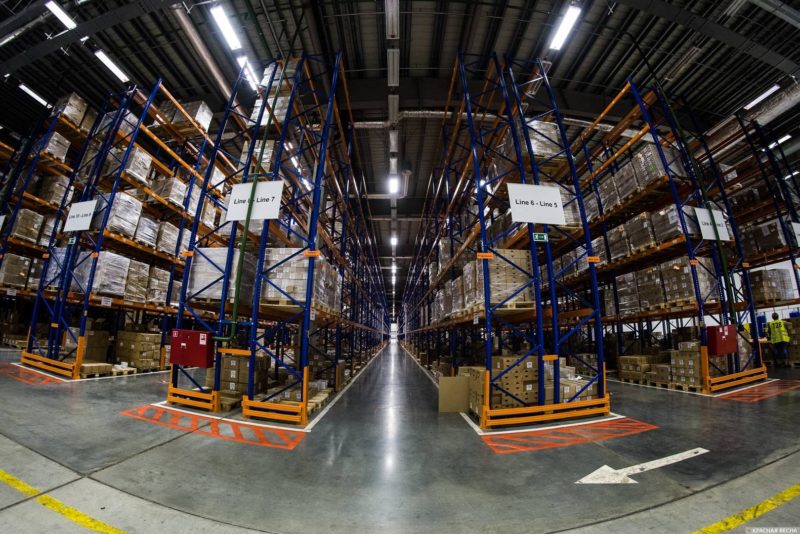
It is obvious that the experience of the Ukrainian-Russian conflict is being studied in various countries. It is quite possible that if new hostilities break out, warehouses containing goods will become one of the first targets.
In July, the zone of active hostilities between Ukraine and Russia shifted from oil refineries and export infrastructure facilities to online marketplaces. The Kiev regime explains strikes on civilian facilities by claiming that military equipment and dual-use goods are being supplied through marketplaces.
In response, the Russian Armed Forces has been systematically attacking logistics centers in Ukraine. Warehouses belonging to Novaya Pochta and the largest Ukrainian marketplace, Rozetka, have come under attack; according to the Russian Ministry of Defense, they are being used as transit points for military cargo arriving from Poland and Romania. Both sides complain about rapidly destroyed commercial empires. On social media, Ukrainians curse Zelensky and his associates for unleashing an infrastructure war that is hitting an entirely innocent civilian population. For Russian society, however, those who did not live through perestroika and the “wild 1990s”, such a situation is something new. Unlike Ukrainians, who have more or less learned to live without water, electricity, heating, the internet, and deliveries of consumer goods through Rozetka and other marketplaces.
The first large-scale attack on Wildberries took place on the night of July 18, 2026. Two major logistics centers were targeted: one in Kotovsk, Tambov Region, and another in Elektrostal, Moscow Region. The strike on Kotovsk, where a complex covering 108,000 square meters had been built, had tragic consequences: according to Tambov Region Governor Yevgeny Pervyshov, seven employees were killed and 25 people were injured. He also said that the drones had been equipped with fragmentation elements designed to increase the number of casualties. In Elektrostal, a UAV attack on the warehouse caused a massive fire that was extinguished only three days later, on July 21. According to Moscow Region Governor Andrei Vorobyov, one person was killed and another 57 were injured.
On July 22, Wildberries warehouses in Krasnodar and Nevinnomyssk, Stavropol Region, were attacked. In the administrative center of Kuban, the fire engulfed more than 100,000 square meters. Krasnodar Region Governor Veniamin Kondratyev reported that one person was killed and 10 were injured; shortly afterward, a woman who had sustained severe injuries died in hospital. A fire also broke out at the warehouse in Nevinnomyssk. According to Stavropol Region Governor Vladimir Vladimirov, five people were injured.
On July 24, the Kiev regime launched a nighttime attack on Wildberries facilities in St. Petersburg and Leningrad Region. The strikes hit warehouses in Shushary and at the Utkina Zavod logistics park in the village of Novosaratovka. The area affected by the fire in Novosaratovka exceeded 50,000 square meters, and three people were injured. By the end of July, the geography of attacks on Wildberries had expanded to Voronezh, Yekaterinburg, Izhevsk, and Sarapul in Udmurtia.
On August 2, the largest warehouse in Samara Region, in a town of Novosemeykino, was hit. According to Denis Gurkov, the regional minister of industry and trade, the fire destroyed 160,000 square meters out of a total of 180,000.
On August 3, a warehouse complex in Sobinsky District, Vladimir Region, was attacked. According to regional Governor Aleksandr Avdeyev, the fire there covered an area of 100,000 square meters, and three people were injured. The following night, warehouses in Krasny Bor in Tosno District, Leningrad Region, and in Emmaus in Tver Region were attacked. In Krasny Bor, where a Wildberries warehouse covering 154,000 square meters is located, a fire broke out.
On August 5, UAVs caused a fire at a 300,000-square-meter sorting center in Aleksin, Tula Region. Tula Region Governor Dmitry Milyaev reported one person injured. The following night and morning, UAVs struck a logistics complex in Tver Region. Regional Governor Vitaly Korolyov said that the facade had sustained minor damage.
Meanwhile, social media users began discussing what exactly had triggered the campaign against Wildberries, given that Ukrainian drones had so far not targeted other major Russian marketplaces. They also wondered whether the difference might be related to the companies’ ownership structures.
However, Mikhail Podolyak, an adviser to the Ukrainian president’s office, then emerged and explained that the strikes on Wildberries were aimed at people who stay out of politics and simply want to make money, without wanting to think about the ongoing hostilities.
“You watch and ‘enjoy’ your business dying. Accordingly, very beautiful pictures… There is no protest potential among small businesses. But when they become bankrupt, then they will have protest potential,” Podolyak said.
In other words, the idea is simple: as another Ukrainian propagandist put it, to make “the war come to every home” in Russia in one way or another, and use this wave to sow unrest within the country.
But having quite reasonably decided that destroying is easier than building, and that protecting one’s own warehouses is more troublesome than bombing someone else’s, Russia began destroying civilian facilities in Ukraine alongside military targets. Incidentally, this suggests that Kiev may have violated some informal agreement limiting strikes against certain types of facilities. Otherwise, it is impossible to explain why the Russian General Staff had been so restrained throughout the previous four and a half years of Russia’s special military operation.
According to the Russian Ministry of Defense, since July 18 there have been at least 11 systematic attacks on warehouse and logistics infrastructure in Ukraine. The main targets were port infrastructure and maritime vessels involved in supplying the Ukrainian Armed Forces. Among the targets hit were 27 maritime vessels, port infrastructure facilities, fuel tanks, warehouses containing ammunition, unmanned aerial vehicles and military equipment, and military-industrial enterprises. Ukrainian sources also reported strikes on warehouses belonging to the Epitsentr, Novus, and Silpo retail chains, as well as attacks on logistics facilities in Dnepropetrovsk, Zaporozhye, and Chernigov Regions, although there was no official confirmation of this information from the Russian side.
On August 4, Vladimir Rogov, chairman of the Russian Civic Chamber’s Commission on Sovereignty Issues, told the newspaper Argumenty i Fakty that the Rozetka marketplace and Novaya Pochta had long been integrated into the logistics of the Ukrainian army, and that their warehouses could contain ammunition, weapons, and military equipment.
At the same time, it is worth noting that Novaya Pochta presents itself as a company that has actively assisted the Ukrainian Armed Forces since 2014, when the so-called “anti-terrorist operation” (ATO) began, during which a war was launched against the population of Donbass. Georgiy Garyuksha, head of the department specializing in the delivery of goods to the front, said in February 2025 that more than 2,000 volunteer organizations assisting the Ukrainian army operate under their umbrella. During the three years following the beginning of the special military operation, more than 130,000 tons of cargo were delivered to the military as part of the program.
The data presented indicate that the attacks on both sides are systematic and escalating. According to estimates by the analytical agency Data Insight as of August 2, the total area of Wildberries warehouses in Russia that had come under attack amounted to as much as 1.5 million square meters, equivalent to 17.2–22.2% of the company’s declared capacity. Restoring these facilities could cost between 62.5 billion and 80.8 billion rubles. Wildberries founder Tatyana Kim said on July 22 that the company’s facilities were insured, but the insurance policies did not cover terrorism risks or the risks of UAV attacks. She did not disclose the total amount of the damage. By the most conservative estimates, however, it runs into hundreds of billions of rubles, and there is nothing with which to compensate for these losses.
According to estimates cited by a number of sources, total economic damage in Russia had reached 340–435 billion rubles by August 3, including the cost of damaged buildings, sellers’ inventory losses, and operating expenses associated with reconfiguring supply chains. Potential losses for sellers resulting from the destruction of inventory are estimated at 214.9–279.6 billion rubles; several hundred thousand entrepreneurs have been affected.
But things are no better in Ukraine. On August 6, Rozetka co-founder Vladislav Chechyotkin reported that the company’s largest warehouse, in Brovary near Kiev, had burned down. It processed more than 100,000 orders per day. He estimated the preliminary damage at “billions of hryvnias” (that is, hundreds of millions of dollars), and warned that the service’s performance would inevitably deteriorate. The businessman also complained about the lack of a functioning insurance system covering cargo against military risks. On the same day, Novaya Pochta co-owner Vladimir Popereshnyuk complained that the Kiev regime had left businesses without protection against attacks. According to him, the changing nature of the hostilities is undermining the capabilities of numerous companies, while marketplaces have lost a combined 1 million square meters of space. Aleksandr Pertsovsky, chairman of the board of Ukrainian Railways, said that attacks on ports had put half of the country’s iron ore exports at risk. Aleksandr Bondarenko, head of the Investment Programs Bureau, forecast a 10–15% increase in prices for goods as sellers attempt to offset their losses.
Surely many people have wondered why Wildberries warehouses burn so readily, given that they are being attacked by ordinary drones with relatively small warheads, which by definition cannot destroy such enormous warehouses. Apparently, the builders or owners of these warehouse facilities violated fire-safety regulations in the interests of economic efficiency. Whether that is actually the case is for the insurance companies to determine when they decide whether what happened qualifies as an insured event.
We will merely note that back in February 2025, an article entitled An Approach to Selecting the Fire Load When Conducting Tests in Mezzanine-Type Warehouse Facilities was published by the All-Russian Research Institute for Fire Defense (VNIIPO) of the Russian Emergencies Ministry. The authors analyzed the fire at a Wildberries warehouse in Shushary of St. Petersburg, which occurred in January 2024, back when no drones were hitting warehouses.
The document indicates that a new type of fire hazard had emerged in connection with the use of mezzanine racking systems structures for storing goods in facilities with high ceilings. This makes highly efficient use of floor space, but it also concentrates tens of thousands of different types of goods in a single location, most of which are highly flammable.
Modern marketplace warehouses are technically considered single-story structures, but the use of mezzanine racks makes it possible to have ceilings 10–15 meters high or even higher, which is already comparable to a five-story building. In effect, such a facility is not simply a storage space for boxes but a chemical reactor under a roof. Yet the requirements for fire-suppression systems there are the same as for small warehouses.
The authors call for the emergence of new types of facilities to be incorporated into regulatory documents and note that, for now, the requirements for fire-protection systems (SP 485.1311500.2020), even taking recent amendments into account, contain only a vague formulation.
It is also worth noting that even before the start of the mass attacks, at the beginning of July, Wildberries and Ozon amended their terms of service, releasing the companies from liability for the loss of goods in the event of military action, terrorist attacks, and UAV attacks. In other words, did they shift the financial burden of the damage onto sellers in advance instead of increasing the level of fire safety? Not to mention that such an emergency amendment to the terms just a few days before the beginning of the mass attacks on warehouses raises suspicions that the owners were aware of the planned operation and had shifted the losses onto sellers.
A separate question is how exactly these losses will affect the company’s creditors. Will they rescue it on the grounds that it is, supposedly, too big to be allowed to die, or will they allow competitors to absorb what remains? The latter will most likely turn out to be paper tigers of their own.
The recent attacks against warehouses represent a new phenomenon, turning civilian logistics infrastructure into a battlefield. The strikes are systematic on both sides of the conflict. For ordinary consumers, these developments mean possible price increases, longer delivery times, and a reduced range of products. For marketplaces and their partners, they mean enormous financial losses and the need for a radical restructuring of their business models. Finding new warehouse capacity, including outside conflict zones, and strengthening the protection of existing facilities are becoming priority tasks.
The new types of attacks have also exposed institutional inertia and demonstrated the consequences of bureaucratic delays during wartime. In June 2026, Sergey Khruslov, deputy head of the regulatory and technical department of the Russian Emergencies Ministry’s supervision and prevention directorate, announced that the first draft of a set of regulations for warehouses using mezzanine storage was being developed. But how much more time will pass before they actually come into force? Moreover, it is important to understand that the experience of the Ukrainian-Russian conflict is being studied in various countries. It is quite possible that if new hostilities break out, warehouses containing goods will become one of the first targets. It is a hybrid war after all
This is a translation of an excerpt from an analytical article by Maksim Karev and Vladimir Koldin, first published on Rossa Primavera News Agency web site.