Trump’s claims to Cuba and other Latin American countries are not just compensation for the failure in Iran, but a long-term strategy, and it is unlikely that the US will abandon it with Trump’s departure from the presidency
On April 30, the 60-days expired during which the US President can conduct military actions without requesting permission from the US Congress. However, long before this, Trump’s military campaign reached an impasse, described by the famous formula “neither war nor peace.” Throughout April, Washington and Tehran simulated a negotiation process, exchanged proposals for a peaceful settlement that were obviously unacceptable to the other side, and mocked each other.
However, the Trump team, having notified Congress of the end of “military actions,” retained for itself the legal possibility to continue them at any convenient moment, again without requesting approval.
Currently, the Strait of Hormuz remains blocked, Trump is not going to unblock it, rather the opposite, he is doing everything possible to maintain the blockade. There is still no talk of any ground operation against Iran — the US does not need it, neither militarily, nor politically, nor in terms of media coverage.
Trump needs a quick victory with minimal costs and risks. And, judging by his rhetoric, the next target could be Cuba, whose military and economic potential, for all the heroism of the Cubans, is incomparable to the might of the US. Plus, Cuba, unlike Iran, is right next door to Trump, and the US is quite capable of sending a military contingent there or conducting carpet bombings, even using its depleted arsenal.
On May 2, speaking in Florida, where the Cuban diaspora is very strong, Trump stated that on its way back from the Middle East, the aircraft carrier Abraham Lincoln could approach the shores of the Island of Freedom, and Cuba would immediately surrender. In response, Cuban President Miguel Díaz-Canel stated that the US is “intensifying its threats of military aggression against Cuba to a dangerous and unprecedented level” and called on the international community to pay attention to this. He also emphasized that no aggressor has ever succeeded in forcing Cuba to capitulate, and the Cuban people are determined to defend the island’s independence.
At the end of March, Trump had already threatened to seize Cuba, but at that time Iran was in focus. Now, having realized that the situation in Iran does not develop in this favor, Trump may well switch to Cuba. Especially since the Cuban leadership is making ambiguous statements that allow for the possibility, at least in theory, of some kind of behind-the-scenes bargaining over the island’s future.
Thus, on March 31, Fidel Castro’s grandson Sandro Castro criticized the country’s authorities in an interview with CNN and called on them to reach an agreement with the US.
“There are many people in Cuba that think in a capitalistic way. There are many people here who want to do capitalism with sovereignty. I think the majority of Cubans want to be capitalist, not communist,” Castro said, adding that, in his opinion, President Díaz-Canel “is not doing a good job.” The younger Castro also believes that an agreement with Trump would be in the interests of Cuba’s economy.
It is worth noting that 33-year-old Sandro Castro is one of the most famous people in the country. He owns a nightclub in Havana and is an influencer. His Instagram (organization banned in Russia) account has over 150,000 followers. So he is a thoroughly modern person, not alien to Western values, and simultaneously a representative of the “ruling” dynasty.
The media notice that recently members of the Castro clan, who had been staying in relative shadow, are increasingly appearing on the pages of the media and participating in politics. In particular, as some American media outlets, including Axios, have claimed, Raul Castro’s grandson — Raúl Guillermo Rodríguez Castro — held negotiations with US Secretary of State Marco Rubio.
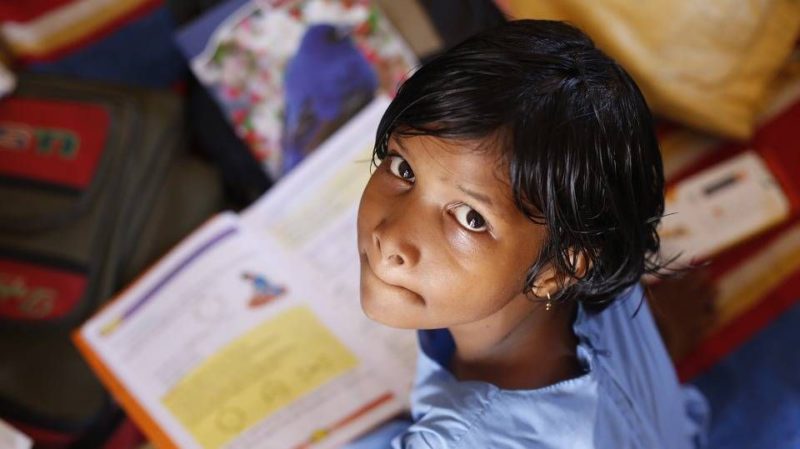
The fuel blockade of the island and, first of all, the cessation of Venezuelan oil supplies have generated an energy crisis, which is leading to growing social discontent, economic difficulties, and undermining the position of the ruling government. Due to a shortage of gasoline, it is practically impossible to remove garbage, for adults to get to work, and for children to get to school. In many grocery stores, shelves remain empty for several days.
It also became known at the end of March that Cuba had approached the Vatican as an intermediary in contacts with the Trump administration. But recently, the Vatican has been openly in conflict with the White House, including over the war with Iran, so the prospects for this mediation are still unclear.
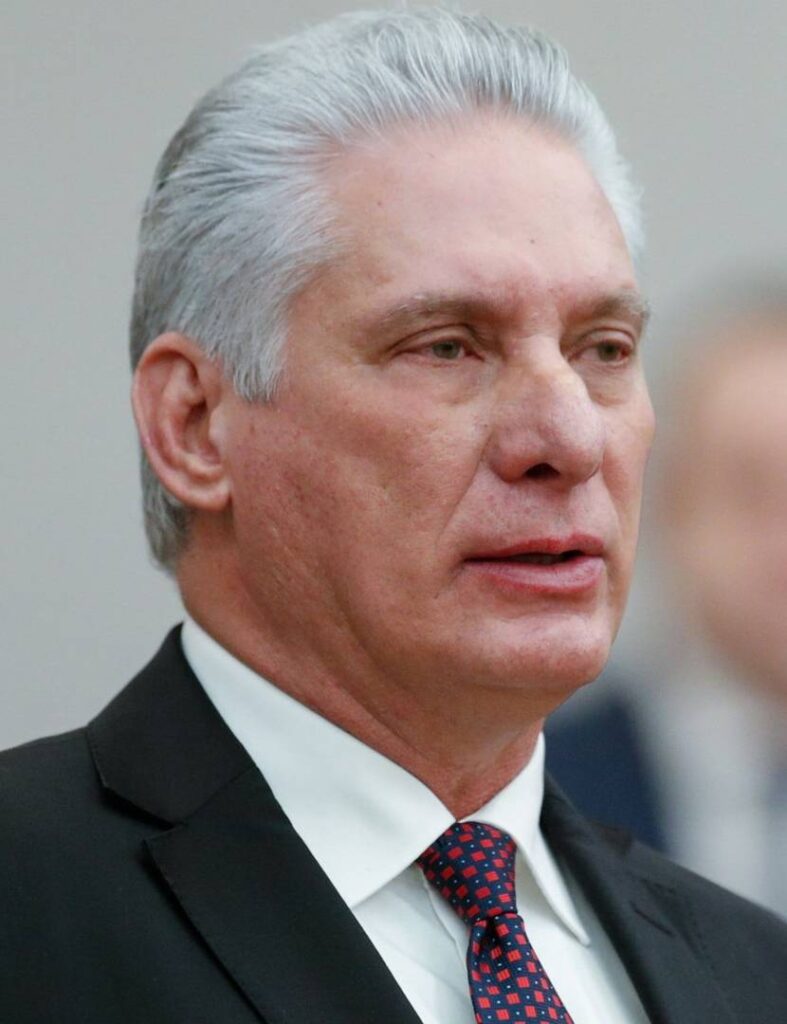
Image: duma gov ru
The example of Venezuela, which in a suspicious way first allowed the abduction of its legitimately elected president Nicolás Maduro, and is now purging the ruling apparatus of his supporters and becoming increasingly controlled by the USA, makes one consider the possibility of a similar scenario in Cuba.
By the way, Trump had also counted on a similar change of the ruling regime to one loyal and controlled by the USA in Iran. But he miscalculated — Iran turned out to be much more monolithic, ideological, and resilient. The whole world sees that the rotation of figures in the ruling regime in Iran only strengthens the readiness to resist US aggression. Unlike in Venezuela.
However, the failure of this approach in Iran does not at all preclude its further testing on Latin American countries. Especially since the US has a clear advantage here, at least due to geography.
At the end of March, Pentagon chief Pete Hegseth, during a speech at the headquarters of the US Southern Command in Florida, presented a new geopolitical doctrine of regional security called “Greater North America.” According to this doctrine, all countries of the Northern Hemisphere form a single defensive perimeter of the US. And thus, they are excluded from the amorphous “Global South” bloc, which is being fostered by the UK as a counterbalance to the US.
The new doctrine involves expanding military presence in coordination with regional partners. From countries located south of the equator, Washington now expects significantly greater participation in “bearing the burden” of defense expenditures — according to the concept, they will have to assume primary responsibility for protecting the South Atlantic and the southern part of the Pacific Ocean without full-scale reliance on the US.
So Trump’s claims to Cuba and other Latin American countries are not just compensation for the failure in Iran, but a long-term strategy, and it is unlikely that the US will abandon it with Trump’s departure from the presidency.
This is a translation of an excerpt from the article No chance of stability by Olga Levandovksaya, Dmitry Vetchinkin, Maksim Karev, first published in The Essence of Time newspaper, issue 669.