If Russia is a garden snail, as Europeans claim, then why are they so afraid of it, constantly talking about a war with Russia around 2030?
Under the cover of peace negotiations on Ukraine and the emerging “divorce” from the United States, Europeans have begun reviving a Reich. Supposedly in order to preemptively protect themselves from the Russian aggression they imagine everywhere. As tradition dictates, the leading role in this is assigned to Germany.
In 2025, Germany spent more on defense than any other European country (if we count in euro, of course). In terms of military expenditures, Germany ranks fourth in the world. It is expected that by 2029 its annual military spending will amount to around €190 billion (a tripling compared to 2022!). German authorities are already discussing a return to compulsory military service if the Bundeswehr fails to recruit a sufficient number of volunteers. As the highly influential American journal Foreign Affairs notes, if this course is maintained, Germany will become a great military power by 2030.
On February 13, a member of the ultraright party Alternative for Germany (AfD), defense expert Rüdiger Lucassen, told the newspaper Die Welt that he would promote a plan to transform Germany into a key state in Europe that would free the continent from decline. Quite a claim, considering that US Secretary of State Marco Rubio, who arrived in Munich, also spoke about the decline of Western civilization and the need to overcome it. Moreover, the current US Administration clearly favor European right-wing forces, both those in power and those only dreaming of coming to power. It is also worth recalling that AfD’s popularity ratings among Germans have caught up with, and in some German federal states surpassed, those of the ruling coalition. Therefore, Lucassen’s statements should be viewed not only as pre-election rhetoric, but also as a public assumption of obligations before the US master.
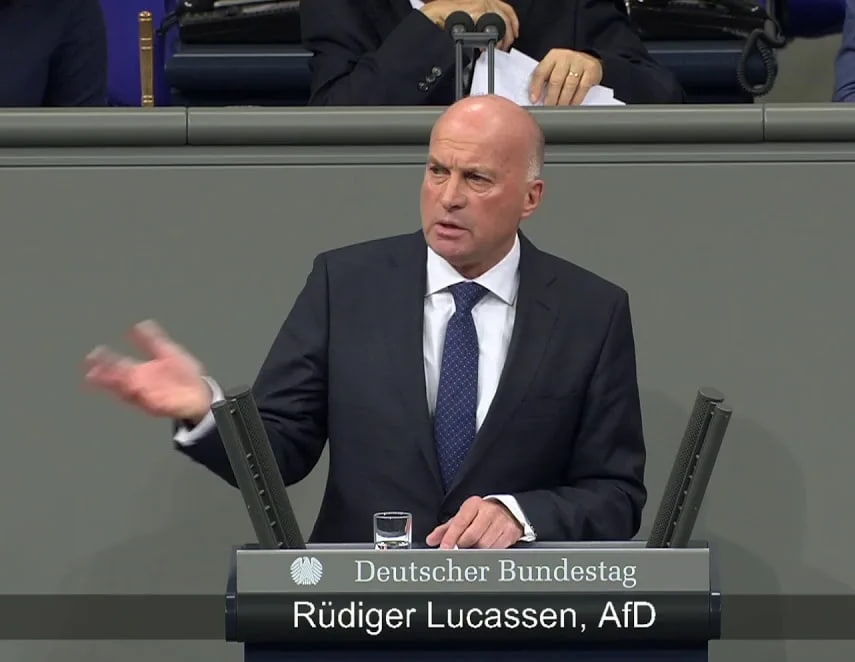
Quote from the video AfD Bayern Rüdiger Lucassen – Klartext im Bundestag zum Einsatz im Irak und Syrien
Lucassen called on Germany to seize the opportunity that emerged after the United States announced a new national security strategy providing for Washington’s disengagement from Europe. This “disengagement” has a very specific character: the US no longer wants to protect Europeans for free or to protect them at all. Now it simply wants to milk them. Hence the demand to increase defense spending within NATO to as much as 5%, along with the accompanying requirement to purchase US weapons. NATO countries, meanwhile, will do what they are ordered to do from Washington. Otherwise, NATO is of no use to the US elites.
According to Lucassen, Berlin must assume leadership, first and foremost in defending NATO’s eastern flank. And this is precisely the region where Europeans expect a Russian “invasion.”
Among other things, Lucassen stated the need to deploy additional divisions and two helicopter squadrons for the Bundeswehr. “Germany’s role as a leading nation also means that smaller partners can rely on us. Not a European army, but a European alliance ready to defend itself,” the politician said.
Lucassen did not explain exactly what his proposal entails (although this is easy to infer from the historical context), but promised to promote his idea at the Munich Security Conference.
Lucassen is one of the few politicians from Alternative for Germany who received an invitation to the Munich Security Conference. The party is represented at the conference for the first time since 2021. At the same time, the German government consistently pressures the AfD, considering them extremists. In some German states, for example in Lower Saxony, the regional branch of the AfD has already been legally recognized as extremist. But Bavaria is not Saxony, and so Lucassen with his ideas of a fourth Reich is a welcome guest at the Munich conference.
In turn, German Chancellor Friedrich Merz, speaking at the conference, hastened to assure that Germany had learned the historical lesson and had forever renounced the role of hegemon in Europe. According to him, great-power politics is a dangerous game — first for small states, and later, probably, for large ones as well.
Now the question is: what do the Germans themselves think about this? Especially considering that from time to time striking evidence appears in the press that Nazism is flourishing within the ranks of German security structures and not only German ones.
And here a very telling report appears that Germany and Ukraine have signed an agreement under which Ukrainians will train Bundeswehr soldiers, passing on to them the experience gained in the war with Russia. The alignment is not only ideological, but also political and military-professional. Germany is being prepared for war with Russia. Whether by that time it will have subordinated all of Europe to itself, or whether Europe will “voluntarily” merge into the German army, is a separate question. But Europeans will wage war openly and with full force. And for that, it is necessary to break the psychological mindset formed after World War II that one should not fight Russia on the battlefield.
On February 13, NATO Secretary General Mark Rutte stated at the Munich Security Conference that Russia wants to appear as a mighty bear in the war against Ukraine, but in reality it is a garden snail. According to Rutte, Russian troops are allegedly advancing very slowly at the front and allegedly suffering enormous losses in the process. Rutte preferred not to elaborate on Ukrainian losses.
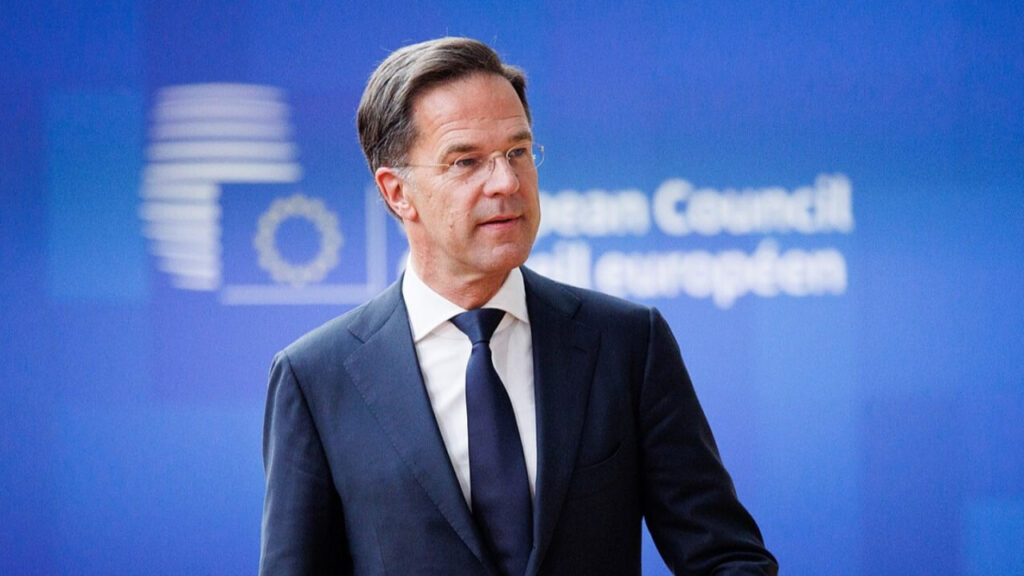
(cc) European Union / Wikimedia Commons
But let us be logical: if Russia is a garden snail, as Europeans claim, then why are they so afraid of it, constantly talking about a war with Russia around 2030? And at the same time sometimes stating that treacherous Russia might attack Europe even earlier — almost in 2027. Yet, if one follows rational logic, this would mean that by that time the conflict in Ukraine will have ended, and ended brilliantly for Russia, because otherwise it would make no sense for it to continue or start military actions in Europe; on the contrary, it would need to focus its forces on reconstruction and establishing normal life in the territories of former Ukraine liberated from Ukrainian Nazis.
But such logic is alien to European elites. The same Rutte admitted at the Munich conference that even if a peace agreement between Russia and Ukraine is reached, NATO will still train and arm the Ukrainian army.
This is a translation of an expert from The power of words and the word of power article by Dmitry Vetchinkin, Maksim Karev, Olga Levandovskaya, first published in The Essence of Time newspaper, issue 661.