If this continues, we may well see a show involving nuclear weapons. And why not?
US President Donald clearly has a special fondness for the date January 3.
Thus, on January 3, 2020, one year before the end of Trump’s first presidential term, the legendary commander of the elite Quds Force of Iran’s Islamic Revolutionary Guard Corps (IRGC), General Qasem Soleimani, was killed in Baghdad as a result of a US missile strike.
That strike became the first link in a chain of events that ultimately led to a serious weakening of the “Shiite axis of resistance” in the Middle East. The apotheosis was the rapid collapse of Bashar al-Assad’s regime in Syria at the end of 2024 and the coming to power of rebranded Islamists nurtured by the USA. In other words, the United States achieved what it wanted by launching the “Arab Spring” in the region. It just took much longer, among other reasons because of Russia’s intervention in the Syrian civil war.
Now Iran’s allies in the region – the Syrian Alawites, Palestinian Hamas, Lebanese Hezbollah, and others – have partially lost their positions, while Iran itself went through a rather painful 12-day war with Israel.
In addition, at the end of December, protests flared up again in Iran, clearly triggered by some faction of the elite in hopes of removing the aging Supreme Leader Ali Khamenei from power.
Accordingly, the weakening of Iran, and now the attempt of regime change in Venezuela, are links in the same chain of struggle against countries that have challenged Washington. At the same time, this is about building a new geo-economic configuration in oil trade. Syria, Nigeria, Venezuela, Iran, and Russia are major players in the existing global oil-trade system. And if earlier experts said that the whole idea of anti-Russian sanctions and the shadow tanker fleet played into China’s hands and that Beijing would eventually restructure oil logistics to suit itself, now it is obvious that the USA wants to prevent this and are taking their own measures, including the use of force.
On January 3, 2026, the US carried out a raid to abduct Venezuelan President Nicolás Maduro, calling it a change of the ruling regime in the country.
For several months off the coast of Venezuela, the US staged a show of muscle-flexing: they built up a military grouping, brought in the largest aircraft carrier, sank fishing boats, and even chased oil tankers. All this looked somewhat comical – like shooting sparrows with cannons. No one believed in a full-scale US invasion of Venezuela, not so much because of the strength of the Venezuelan army as because of the utter futility of conducting military operations in the local jungles. Ordinary Venezuelans hate the damned gringos far more than their own authorities, however inefficient those may be. Therefore, it was believed that the most likely scenario would be either a swift airborne operation or missile/air strikes on the country’s most critical facilities accompanied by an ultimatum.
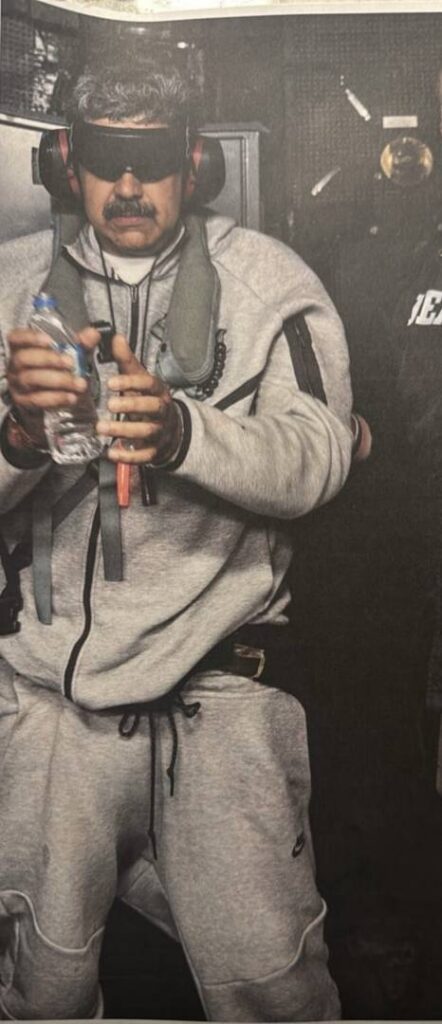
The US chose the first option, and, as President Trump reported on social media, special-forces units simply kidnapped President Maduro along with his wife, took them to the United States, and now intend to put them on trial by the “most honest and incorruptible” court in the world.
The charges announced by US Attorney General Pam Bondi against Maduro were actually brought back in 2020 and sound somewhat absurd. Maduro is accused of allegedly plotting against the United States, conspiracy to commit narco-terrorism, conspiracy to import narcotics, unlawful possession of automatic weapons and explosive devices. The very wording of these charges indicates that Maduro and Venezuela are viewed by the Americans as part of the United States, since such accusations can be applied to U.S. citizens, who are legally prohibited from certain actions, but not to the leader of a sovereign state living under its own laws.
Moreover, the Americans are not even trying to cover their actions with references to international law, because their actions buried that law long ago. With regard to Venezuela, Trump is acting in full accordance with the recently published National Security Strategy, which represents an updated Monroe Doctrine. According to this doctrine, the United States considers the entire Western Hemisphere its back yard, and therefore does not care about the laws and borders of those states that were “lucky” enough to be in the same hemisphere with it.
In his rhetoric toward Canada, Mexico, and especially Venezuela, Colombia, Cuba, and others, Trump directly calls these countries and their resources US. He openly refers to Venezuelan oil as US and accuses the country’s authorities of nationalizing US companies that operated there before Hugo Chávez came to power.
Having kidnapped the lawfully elected president of a sovereign country, Trump brazenly declares that during the transition period the US elites will govern Venezuela. But how is this even technically possible?
Let us not yet discuss in detail whether there was some kind of deal between the Venezuelan military and Washington regarding the handover of Maduro. Based on what is currently known about this “brilliant operation,” no unambiguous conclusion can be drawn. First and foremost, there is a huge amount of disinformation spread by Western media.
Secondly, there are a number of very suspicious circumstances. For example, heavy US helicopters brazenly flew over the capital Caracas on a clear night under a full moon, and not a single air-defense missile was fired at them. Not even a single burst of automatic fire. The USA later claimed that they had supposedly suppressed all air defenses, but that is hard to believe, given that in the preceding days they had been sinking boats.
A series of diversionary strikes on the area where the Miraflores presidential palace is located, according to locals, was caused by explosive devices planted in advance rather than by missile hits. Such devices could have been planted by traitors on the ground to divert attention from the real objectives. At the same time, the barracks near the palace remained untouched, and no soldiers were put on alert.
There is also no clear information about an assault on Maduro’s residence. Yet such an event should have left at least some media trace, especially since armored vehicles were nevertheless pulled up to the Miraflores palace.
Now the country’s defense minister, Vladimir Padrino López, is bringing people out into the streets and promising to defend the country’s sovereignty with weapons in hand. That is commendable, but it does not explain how the air defenses and everything else slept through the president’s abduction.
Third, earlier the press reported that Trump’s team had long demanded through special channels that Maduro voluntarily resign, take a payoff, and move somewhere to Qatar. Along with Brazil, Gulf monarchies and Turkey reportedly took part in these specific negotiations (if they indeed took place).
And last but not least, everything that is happening looks like a typical Trump show, because the focus is on a pretty picture and media effect rather than practical results. In the end, Trump got Maduro, not Venezuela. To establish control over Venezuelan oil resources, a great deal more work needs to be done. Formally, power has now passed to Vice President Delcy Rodríguez, who simultaneously serves as Minister of Petroleum and Hydrocarbons. In Maduro’s government, she was responsible for dialogue with the West regarding oil production and sales. Perhaps in Maduro’s absence she will be somewhat more сщьздшфте but only somewhat. If, according to the law, a new presidential election is held in 30 days, it is not a given that she or any opposition candidate will win. The previous elections in 2024 showed that Maduro significantly outpaced both María Corina Machado and her running mate Edmundo González Urrutiaб who is closely linked both to death squads in El Salvador and to the CIAб in the number of votes cast for him. Betting that the conditional Rodríguez is less popular than Maduro and therefore will lose to the opposition is, to put it mildly, naive.
If the Venezuelan ruling party is so dangerous as the Western media claim, it will not simply give up power. Especially since in the eyes of the poor its rating will rise sharply amid US interference.
By the way, Trump no longer wants to see Machado at the head of Venezuela, preferring González instead whom the United States already recognized as the winner of the presidential election back in August 2024. González is clearly tougher and more ferocious than the Nobel Peace Prize laureate Machado, but over the past year and a half his chances of being elected have hardly improved.
The option of a color revolution, when a supposedly democratic opposition supposedly comes to power more or less peacefully, has apparently already been discarded by Trump. The previous bet on Juan Guaidó, whom the Trump administration nurtured during his first term as a leader and alternative president, either did not pay off or caused Trump a fundamental disappointment in this method. Therefore, Trump has now returned to the good old methods of force.
But by kidnapping Maduro, the US have gained no lever that would allow them to influence elections in the country. If this were an intervention and a forceful change of power followed by “transparent democratic elections” under the barrels of US rifles, then yes, a puppet pro-US regime would come to power in Venezuela. But when they just kidnap the president (or would have killed him — the essence does not change), leaving his entire team and administrative apparatus in power, there can be no talk of control over the country.
Control through force presupposes at least partial occupation and seizure of oil fields.
As for intervention, Trump has stated quite unequivocally that he will not go for it. And it is clear why: he does not need the corpses of US soldiers ahead of congressional elections. He needs triumph and glory. And, moreover, he needs to scare the rest of the uncooperative Latin Americans. Trump has voiced rather unambiguous threats toward Mexico, Cuba, and Colombia.
Ideally, Trump needs to continue his conservative revolution and bring right-wing forces to power in Latin America, as has already happened in Honduras and Chile. And, of course, the elections this fall in Brazil are crucial for Trump. He would very much like to remove Lula da Silva and help bring a Trumpist nationalist, Jair Bolsonaro, to power.
In 2026, elections will take place in Colombia and Brazil. In both countries, the left will actively exploit the rise of anti-US sentiment. Trump has already had to remove tariffs against Brazil, as they hit the US economy as well.
And Brazil is an important element of BRICS, so the stakes are indeed high. Trump needs simultaneously to strengthen US positions in the Western Hemisphere, the positions of Republicans at home, and strike at the BRICS linkage.
But this “brilliant” operation to take Maduro to the United States is unlikely, in the medium term, to allow Trump to solve even one of his current problems.
If things continue like this, we may well see a show involving nuclear weapons. And why not? After all, Trump recently admitted in an interview that he likes watching explosions. And a nuclear explosion looks very impressive, especially if you watch it from a well-equipped bunker.
This is a translation of the part of the text from the weekly overview of the most important events by Maksim Karev, first published in The Essence of Time newspaper, issue 656. The text id dedicated to the US raid in Venezuela.