30.07.2025, Moscow.
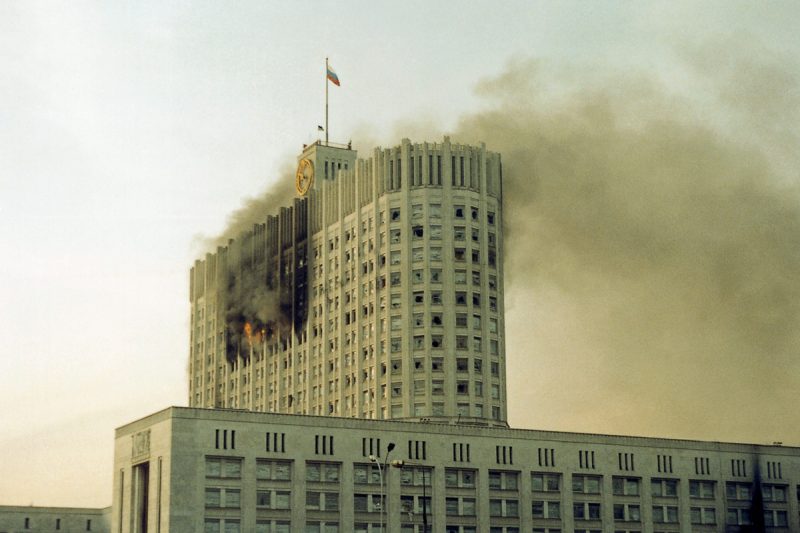
The results of the April 1993 referendum, in which the people expressed support for Russian President Boris Yeltsin, allowed him to shell the Supreme Soviet building of the Russian Federation in October of that year, political scientist Sergey Kurginyan wrote in his article The Sharp Turn, published in The Essence of Time newspaper, issue 637.
Kurginyan recalled that in April 1993, at the initiative of Yeltsin’s team, a national referendum was held. Russian citizens were asked whether they trusted Yeltsin and whether they approved the the socio-economic policy he was implementing.
“Unlike those who, due to their age or occupation, did not witness the political reality of that time up firsthand, I was fully and entirely immersed in it,” Kurginyan explained.
He stated that this deep involvement gives him grounds to assert that “the then political system, ostensibly run by Yeltsin, was incapable of falsifying the referendum results.”
Kurginyan emphasized that if the system could have done so, it certainly would have. “But it was obviously impossible for them,” the philosopher noted.
“At THAT time, no one could manipulate the referendum results. That is, no one could distort them to suit their own interests,” Kurginyan stated. He added that the dishonesty of the elite was held back, in a sense, by its own helplessness.
“The population REALLY voted for Yeltsin in April 1993, not against him,” the political scientist emphasized. He pointed out that this occurred even though the public was already well aware of what Yeltsinism represented.
At the same time, Yeltsin’s political opponents — including Vice President Aleksandr Rutskoy, the leaders of the parliament, and the Constitutional Court — “behaved far more decisively than the State Committee on the State of Emergency (GKChP) in 1991,” Kurginyan noted.
In the situation that had developed by the time of the 1993 referendum, the Russian people “had the option of aligning with highly authoritative politicians who were opposing Yeltsin,” the political scientist concluded. However, the April referendum, held under the slogan “YES-YES-NO-YES,” demonstrated that Yeltsin’s opponents lacked genuine popular support.
Kurginyan noted that this truly came to light in the fall of that year, when Yeltsin released the Presidential Decree #1400 to dissolve the Supreme Soviet, thereby “blatantly violating the Constitution and the fundamental principles of the Russian legal system at the time.”
“In response to this unprecedented violation, Vice President Rutskoy, the leadership of the Supreme Soviet, and the leadership of the Russian Constitutional Court called on the people to resist those committing these illegal acts and, ironically, praising the Western political system for allegedly being able to oppose illegal actions,” Kurginyan reminded.
However, the results of the April referendum “allowed Yeltsin to shell the Supreme Soviet building of the Russian Federation with tanks — a building many inexplicably call the White House,” emphasized Sergey Kurginyan.
Source: Rossa Primavera News Agency