The global energy shortage is being turned into a weapon to reshape the world order: by cutting off fuel supplies, the architects of chaos are setting the stage for famine, mass migration, and new wars.
Having shaken the stability in the Persian Gulf, the US elites have now decided to withdraw from the region once and for all, leaving behind not even ruins, but chaos. In the medium term, this is worse than ruins, since ruins can be cleared away, restored, and rebuilt, whereas chaos prevents any such possibility. The Gulf monarchies have been designated as the main victims, having long considered themselves the hegemon’s principal allies in the Middle East. Trump’s actions have already broken the petrodollar pump that had reliably transferred Arab sheikhs’ money into the US economy, the sheikhs still have money that the USA would like to expropriate.
At the same time, the United States is openly unwilling to protect the Saudis from the increasingly aggressive attacks by Yemen’s Ansar Allah movement. Ansar Allah is targeting not only Saudi oil industry facilities and military bases, but also Jeddah, Saudi Arabia’s second-most populous city, and its surrounding areas.

Jeddah is an ancient transportation hub for pilgrims performing the Hajj to Mecca and Medina. Strikes on airports in Jeddah are forcing many Muslims traveling to the holiest sites in Islam to seek alternative routes. This is unsafe and quite costly in material terms. In turn, this is generating a wave of complaints against the Saudi royal family, which is unable to ensure security for pilgrims. Under certain circumstances, and with the right investment, these complaints can easily be turned into a reputational attack portraying the Saudis as poor custodians of Islam’s holy sites.
The next question will be: who should replace them? Especially since everyone can see that they have become both weaker and poorer. In addition, many radical Islamist groups have been financed by the Saudis. If this financial stream dries up and a struggle for the Saudi inheritance, the Islamist networks, begins, the consequences will extend beyond the Middle East to the entire world, wherever these Islamist networks exist. And they exist everywhere, including Latin America.
Now, on to energy.
The number of new oil and gas fields discovered worldwide in 2025 fell to its lowest level in 45 years, according to Japan’s business newspaper Nikkei. The reason is simple: oil companies have been cutting spending on geological exploration for many years. Incidentally, in Russia, the price of oil is largely determined by the high cost of geological exploration and extraction, unlike in blessed Saudi Arabia, where the cost of producing a barrel of oil is among the lowest in the world. And the oil itself is among the best.
As usual, savings on geological exploration did not make themselves felt immediately, but they eventually did. Even if investment in finding and developing new fields begins right now, the positive effects will not become apparent for several years.
The situation has now been aggravated, first, by the blockade of the Strait of Hormuz and the Bab el-Mandeb Strait. Second, oil exports from the Middle East have been reduced, in part by the blockade and in part by cuts in production resulting from Iranian and Ansar Allah attacks on the oil infrastructure of the Gulf monarchies. The reduction is substantial, amounting to as much as 2 million barrels per day. Third, Russian exports have fallen by approximately the same amount, due to the Western sanctions and Ukrainian strikes on Russian oil refineries and oil-loading terminals.
Finally, the development of artificial intelligence requires the construction of an ever-growing number of data centers around the world, and these consume enormous amounts of electricity.
Thus, energy production is objectively declining, while demand for it is growing rapidly. This is why we have recently been witnessing a series of moves in this area. The “diesel deal” concluded between Russia and the United States in early October is just one element of the picture, and by no means the largest. For example, the Trump administration recently authorized the sale and return to legal circulation of some vessels belonging to the so-called shadow fleet.
Also interesting is the dispute between Trump and Larry Fink, CEO of the notorious investment fund BlackRock, over who should supply electricity to data centers that are under construction or still in the planning stage. Trump’s position is essentially that they should provide their own power, build generating capacity, and sell any surplus to local residents. Fink, meanwhile, insists that a slowdown in data center construction could push the US economy into recession. According to him, too much of the United States’ current economic growth already depends on capital investment in artificial intelligence infrastructure.
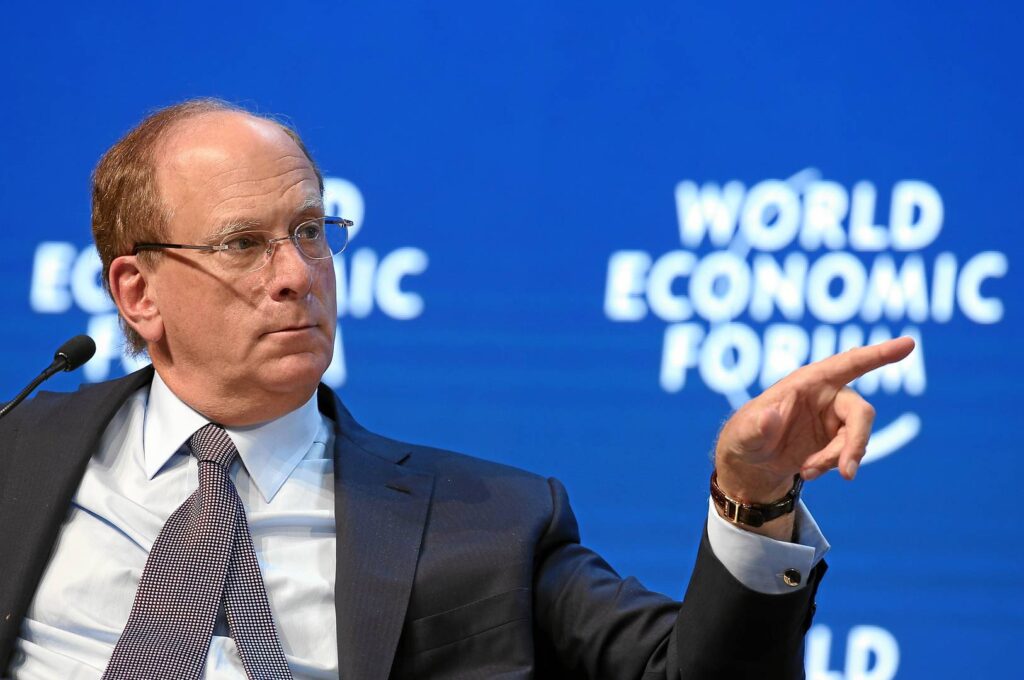
Image: (cc) World Economic Forum
On the one hand, the question of who will bear the costs of building the associated energy infrastructure, a matter involving tens of billions of dollars, remains unanswered. On the other hand, power does not come out of thin air. It requires either hydrocarbons, which are in short supply; coal, which has been abandoned slowly and painfully under the banner of “green energy”; or nuclear power plants, which are an entirely political issue. Ultimately, under conditions of energy scarcity and the impossibility of overcoming it quickly, the issue boils down not to building new generating capacity but to reallocating existing fuel supplies, that is coal, oil, gas, diesel, uranium, and so on.
Moreover, control is needed not only over reserves but also over the logistical routes used to deliver them. In other words, the division of the world’s future energy base is beginning: oil and gas fields, pipelines, refineries, tankers, and strategic maritime chokepoints. Some routes and facilities are being put out of action and disconnected from global supply chains, while new ones emerge in their place. Or they do not emerge, if a specific region becomes cut off from resources.
Food crisis follow closely on the heels of energy problems. No diesel fuel means no sowing or harvesting. No gas means no fertilizers, which means lower crop yields and then famine and social unrest. This will not happen immediately, but with a delay of four to six months. In countries with cold winters, energy shortages will lead to heating problems. A major consequence will be mass migration to countries where heating, electricity, food, and drinking water are available. As a result, conditions in the countries to which migrants flock will deteriorate sharply: competition for resources and jobs will intensify, and public budgets will come under greater strain. This, in turn, will fuel interethnic and interfaith tensions.
This is how flashpoints of future chaos are taking shape, ready to be “switched on” whenever necessary. Protests in Europe are only the beginning.
Another significant change is the shift in rhetoric. In mid-October, Saudi Deputy Foreign Minister Rayed Krimly stated that certain entities in some countries, including commercial organizations, might be providing Iran and Ansar Allah with technology and intelligence that facilitate attacks. This is not yet a direct accusation against the leadership in Moscow and Beijing, but it is already a way of testing the waters.
Meanwhile, Russian President Putin held talks with a US delegation in St. Petersburg, during which the Iranian issue was also discussed. Shortly before that, Russian Foreign Minister Lavrov had visited Tehran, and consultations between Iran’s supreme leader and the country’s leadership had taken place inside Iran itself. Some experts believe that the diesel deal and Trump’s other gestures toward Moscow are an attempt to drive a wedge between Russia and Iran.
It is also worth noting the efforts by journalists to portray the planned trilateral meeting between Putin, Trump, and Xi Jinping in November as a kind of equivalent to the 1945 Yalta Conference agreements. But all historical analogies are flawed, and the analogy with Yalta doesn’t stand up to scrutiny.
First, the Yalta Conference, at which the world was effectively divided into two spheres of influence, namely the Soviet sphere and the Anglo-American sphere, became possible because the Allies had defeated fascism. As things stand, we see no victory over fascism, nor do we see any allies, especially when it comes to Ukraine, which the United States has actively supported since the very beginning of the special military operation.
Second, even if we consider victory over Banderite Ukraine to be a settled matter, how could such a victory serve as the basis for a new division of spheres of influence?
Third, what does China have to do with it?
Last but not least, shortly after Yalta, Churchill delivered his famous speech in Fulton, which became the starting point of the Cold War. Of course, a cold war is much better than a hot one, but in that case, we should not present agreements that have not yet been reached as a peace settlement. Especially since no one yet understands exactly what each side will gain from such an agreement or what each side will have to pay for it.
This is a translation of an excerpt from the article “Physics and Clerics” by Maksim Karev and Vladimir Koldin, first published on Rossa Primavera News Agency web site.