14.04.2026, Tallin.
The Baltic countries jointly disavowed permissions for Ukrainian drones to fly over their territories, sending a corresponding statement to the Ministry of Foreign Affairs of Russia. Later, Estonia refused to detain Russian tankers in the Baltic Sea, citing a possible “risk of military escalation.” Rossa Primavera News Agency Europe Desk discusses why the Baltic Stats suddenly backtracked amid worsening relations with Russia.
On April 10, the press service of the Estonian Foreign Ministry published a joint statement by the foreign ministers of Estonia, Latvia, and Lithuania, in which they denied Russia’s accusations of providing their airspace for the flight of Ukrainian drones.
“The Baltic countries have never allowed the use of their territory and airspace for drone attacks on targets on the territory of Russia,” the statement reads.
During the drone attacks on Russia’s Leningrad Region in late March and early April, Ukrainian drones were spotted in the skies of all three Baltic republics. Falls of Ukrainian UAVs were also recorded in Lithuania, Latvia, Estonia, and Finland.
Moscow issued a special warning to the Baltics states due to the decision to open airspace for Ukrainian drones to fly through during attacks on Russia and threatened an appropriate response if the Baltic authorities continued to provide open airspace for Ukrainian drones.
After the vague excuses of Baltic politicians that the Ukrainian drones flew in “accidentally,” the Baltic states had to issue a collective statement denying their involvement in the Ukrainian attacks in order to avoid further escalation of relations with Russia.
The second step toward reducing tensions in the Baltic region was a statement by the Estonian navy that they would no longer detain Russian tankers in the Baltic Sea, because, as Estonian Navy Commander Ivo Värk said, “the risk of military escalation is too high.”
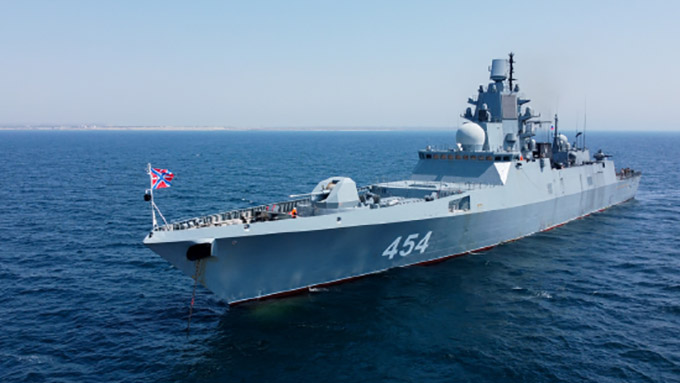
Both of these statements were published almost immediately after news emerged that two Russian oil tankers were being escorted by Russian Navy warships through the English Channel. Despite their earlier threats of the British officials to board all “shadow fleet” vessels that approached British territorial waters, the UK had to watch the Admiral Grigorovich sail through its waters and limited themselves to outrage in the newspapers.
One can only assume that the Baltic countries’ instinct for self-preservation finally woke up, and seeing the lack of a strong reaction from the British to the Russian warships, they decided to follow their example and likewise temper their martial fervor.
Source: Rossa Primavera News Agency