Popular indignation in France, Spain, and other countries certainly has a basis. The economic and social situation of ordinary people continues to deteriorate. In this case, protests become a political instrument for reformatting the European political landscape toward the right.
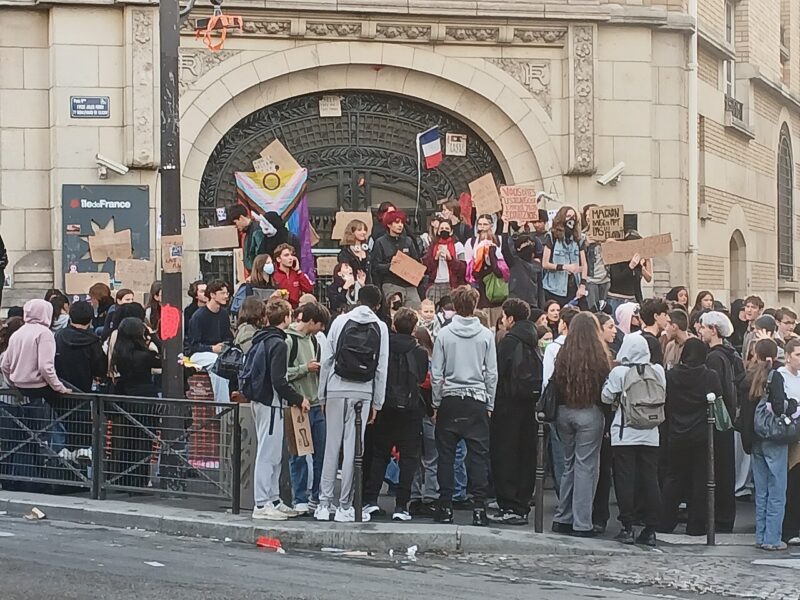
Europe, suffering from economic turmoil, has been shaken by a wave of protests. The pretext for the street activity was unpopular austerity measures and cuts to social spending. As usual, the French took the lead, the student protests in France that began in September in the poor suburbs of Paris spread across the entire country within days, interspersed with outbreaks of violence.
On October 9, the capital of neighboring Belgium, Brussels, saw large-scale clashes between demonstrators and law enforcement, flaring up against the backdrop of a nationwide workers’ march. Student groups, whose protests have been ongoing since the beginning of October in Liège and have spread to Brussels, say they are protesting against rising education costs, overcrowded lecture halls, and reforms that they fear will make higher education less accessible.
In Italy, students have expressed solidarity with their French counterparts, demanding that the authorities increase social spending instead of austerity programs.
In Austria, students also took to the streets over the government’s plans to cut the higher education budget by €1 billion in the period 2028–2030, which threatens mass closure of courses and dismissal of academic staff.
In Spain, the cause of the protests is different: tens of thousands of people in major cities held mass demonstrations demanding that the government immediately intervene in the catastrophic housing crisis caused by uncontrolled growth in rental prices and the dominance of tourist apartments. However, these processes have something in common that is not particularly discussed in the media. As an example, let us examine in more detail what is happening in France and Spain.
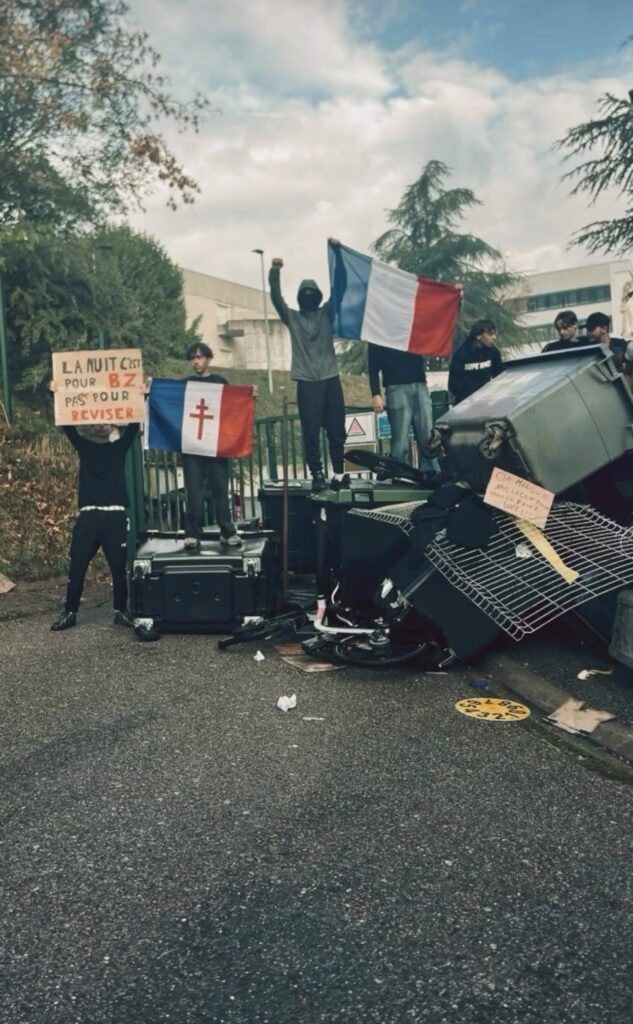
Image: (сс) CynaoMathou
In France, about a third of all high schools in the country are engulfed in unrest; 500 of 3,700 schools had temporarily closed by Monday, October 5. Police have already detained several thousand people, mostly teenagers aged 15–18. Radicals and rioters quickly joined the ranks of the protesters.
With the help of social media, the protest movement instantly grew into a nationwide one. By September 21–25, protests had spread to the entire Paris region of Île-de-France, and by September 28 they had covered Lyon, Lille, Nice, and Nantes. High school students barricaded the entrances to 180 lycées across the country with trash bins.
The peak of the protests in France came on October 1, when the French Interior Ministry recorded about 900 actions and incidents. The demonstrations were accompanied by clashes with police, arson, and damage to schools. On October 2, due to mass unrest, the authorities announced the closure of 564 educational institutions, and more than 400 lycées were switched to remote learning.
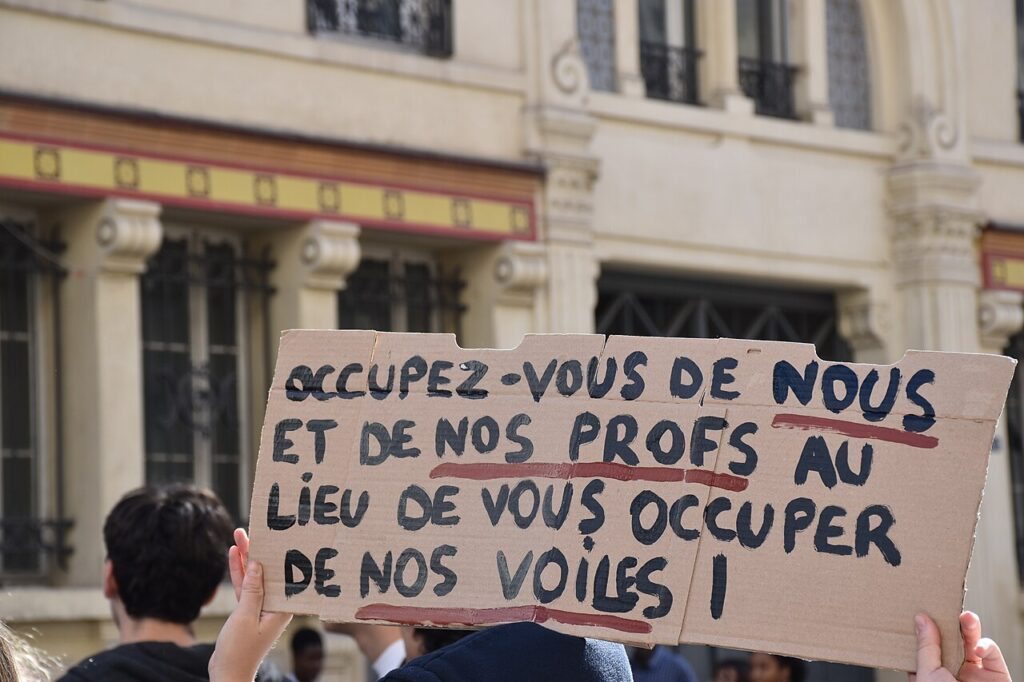
According to most analysts surveyed by the media, the protests erupted amid discussion of the draft state budget for next year: in order to reduce the state debt, the government intends to cut social allocations, including education spending, while simultaneously increasing military spending. In other words, why should French students study if the government will send them to war anyway?
On the one hand, the French budget has long been hopelessly in deficit, state debt is growing faster than revenues, and sooner or later this will lead to collapse or war. Which will write off everything. On the other hand, as experts note, almost every generation of French high school students rebels against the current education minister. It is a kind of rite of passage into adulthood.
However, every such discontent, no matter how just and well-founded its causes, has interested parties who use such outbursts to their own advantage.
Minister of National Education Édouard Geffray acknowledged that the students’ demands regarding learning conditions are justified, while stating that the spontaneous movement of high school students had been “held hostage by ultra-violent marginal groups.” A culprit was found (or appointed) fairly quickly, the French government accused the left-populist party La France Insoumise and its leader Jean-Luc Mélenchon of using the protests to prepare for the 2027 presidential race. The protesting teenagers do not hide their sympathies for leftist ideas: among the slogans they display on their posters is “Zoomers are communists!”
However, political calculation suggests the opposite: the radicalization of protests benefits the right, since it creates a public demand for restoring order.
The French presidential election is scheduled for April 18, 2027. Incumbent President Emmanuel Macron will not participate. The French Constitution prohibits holding the presidency for more than two consecutive terms. And according to recent polls, the favorite in the presidential race is National Front leader Marine Le Pen, who for this purpose was even released from prison in July and had her sentence commuted, allowing her to participate in the elections. According to the same poll, second place in the candidates’ rankings is held by… Jean-Luc Mélenchon. At the same time, in the second round, Marine Le Pen will retain the lead under any scenario. Her greatest advantage is precisely in comparison with Mélenchon – 69.5% against 30.5%. Thus, if the protests that began in France have become a prologue to the 2027 elections, they work precisely for Le Pen’s victory over Mélenchon, drawing votes away from the centrists of the Macron camp.
So, whoever has taken control of the student protests needs to bring the right-wingers to power in the country. This will be a significant change: if the government under President Hollande was center-left, under Macron it was centrist with a distinct shift to the right in the second term, then a Le Pen government will be finally and irrevocably right-wing.
Having noted this, let us look at what is happening in Spain.
In Spain, Prime Minister Pedro Sánchez, against the backdrop of the protests, has once again announced snap elections to jump onto the departing train of power before his personal ratings finally collapse.
The main trigger and symbol of the national revolt of the Spaniards was the tragic story of 87-year-old María del Carmen Abascal (Maricarmen). A major international investment fund bought the house in Madrid where the woman had lived for about 70 years and raised her rent from €500 to €2,650 a month. The pensioner did not have that kind of money. On September 23, police evicted the elderly woman; she was carried out of the apartment on a stretcher, and footage from the scene instantly spread across the country. On October 7, unable to bear the stress she had endured, she died in hospital. This news provoked new hundred-thousand-strong memorial marches under the slogans “Maricarmen is alive, the struggle continues!” and “Not one more Maricarmen!”
To somehow calm the just indignation of the Spaniards, Sánchez’s left-wing government urgently submitted a package of laws to protect tenants to parliament. The program included:
-
Introduction of a moratorium on forced eviction of vulnerable groups of the population until 2030.
-
Restriction of short-term and seasonal rentals (tourist apartments) with a special tax.
-
Automatic extension of existing rental contracts on the same terms.
But on October 2, 2026, the vote in parliament on these items failed; the bloc of right-wing forces (the People’s Party and Vox) voted against, as well as the Catalan separatists, who considered the laws an infringement on the rights of property owners. This, by the way, is quite in the spirit of the right across Europe. In Germany, for instance, virtually no party, including the right-populist AfD, encroaches on the rights of the main property owners.
On October 5, Sánchez dissolved parliament and announced early elections, deciding to make the housing issue the main card of his election campaign. However, the protests continue, and in a number of cities they are even getting out of control. Thus, in Valencia, demonstrators tried to seize the famous cultural complex City of Arts and Sciences, which led to clashes with police, who used tear gas and rubber bullets.
Popular indignation in France, Spain, and other countries certainly has a basis. The economic and social situation of ordinary people continues to deteriorate. But it would be naive to reduce everything to a series of mistakes by one government or another whether left or right. Essentially, in the Western world, the so-called consumer society is being rolled back. The volume of public goods is being reduced, including affordable housing, education, healthcare, pensions, kindergartens, jobs, and so on. In this case, protests are a political instrument for reformatting the European political landscape toward the right. The lefties are to be replaced by centrists, the centrists by moderate right-wingers, the moderate right-wingers by ultra-right-wingers. In certain countries, a sharp leap is also possible from lefties to right-wingers.
Spain is the only country where a conditionally left-wing government is in power. Conditionally, because modern pseudo-leftists in Europe or Latin America are, roughly speaking, branches of the US Democratic Party, and European right-wingers, also very roughly, are branches of the Republican Party. Trump supports right-wing governments in Europe because such a fragmented, nationally oriented, conflict-ridden Europe is far more obedient than a consolidated European Union. Which now also gravitates toward the United Kingdom (and toward Canada, as an alternative to the US with its oil and access to the Arctic), which greatly infuriates Trump.
Accordingly, the right-wing undermining of Sánchez is happening in the interests of Trump and his team. And exactly the same is happening now in Brazil, where leftist Lula da Silva and Trumpist Flávio Bolsonaro are competing for the presidency.
By the way, almost half of the Spanish housing market is controlled by US investment funds. In Germany, the ownership scheme is more convoluted, but overall the US is one of the largest players in the real estate market. So, if desired, one could provoke protests here too, to play along with one’s protégés in the elections.
And as one more touch to the picture of refined US-European relations. Recently, The Wall Street Journal wrote that in March, at a dinner in Athens attended by Greek and US officials, Kimberly Guilfoyle, then US Ambassador to Greece, demanded that Greek Energy Minister Stavros Papastavrou purchase US LNG. And for greater persuasiveness, she threatened to bring down the Greek government, citing the collapse of the Romanian government as an example, “We can do that to any country we want. We can do that here.”
A video has already surfaced online showing Guilfoyle on March 31 meeting with leaders of Romania’s Social Democratic Party in a Bucharest hotel. Six days later, the Social Democrats, together with the far-right AUR party, went ahead and brought down the government headed by Prime Minister Ilie Bolojan, which had resolutely opposed purchasing US LNG at above-market prices.
Greece, of course, is not Romania, and it is unlikely that the US elites will be able to bring down a single-party majority government so easily, but the main thing here is the US’s readiness to impose its will, regardless of anything and by any available means.
So beware of Greeks bearing gifts.
This is an excerpt from the article by Maksim Karev, first published on Rossa Primavera News Agency web site.
Translator’s note: The article was published on October 17, 2026 on the eve of recent escalation of the student protests in Europe.