In mid-October, the USA clearly demonstrated to the Ukrainian regime the full extent of its dependence on Washington’s will. On October 13, the Ukrainian Armed Forces suddenly experienced problems with Starshield equipment, which is used to control interceptor drones. Ukrainian militants said they noticed “speed restrictions” when using the Starshield internet dishes from Elon Musk’s company SpaceX.
At speeds above a certain level, internet access disappeared, and interceptor drones went out of control, deviating from their course. Sources in the Ukrainian Defense Ministry stated that SpaceX unilaterally imposed restrictions on the use of the Starshield system without notifying anyone in advance.
On October 17, Zelensky stated that the speed restrictions prevented Ukraine from using Starshield to intercept new Russian jet-powered Shahed drones.
After lengthy squabbling, Musk was made the scapegoat. On October 20, CBS News wrote that he had repeatedly communicated with administration officials, trying to clarify President Trump’s position on the matter.
On October 22, responding to journalists’ questions about whether he had asked Musk to restore communications with Ukraine, Trump said, “I don’t want to comment on it, whether I called or whether somebody else called, doesn’t make any difference, I guess. The bottom line – he put it back.”
On October 24, Musk acknowledged that he had limited the speed of Starlink, stating that the Ukrainian militants had violated the terms of Starlink service provision.
There is certain confusion here that needs to be clarified.
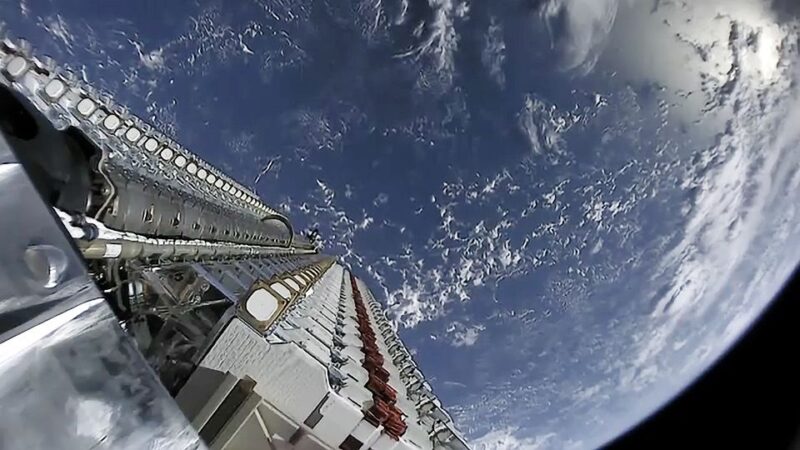
Starshield is a military satellite network; it operates on the same satellite constellation as its civilian analogue Starlink but has fewer technical restrictions and more advanced security features. Both networks are operated by SpaceX, which is owned by Musk.
Ordinary Starlink terminals have a speed limit of 70 km/h, which corresponds to the speed at which one can use the internet in a moving car. When the speed is exceeded, the quality of the internet deteriorates, and it becomes practically unusable. This is done deliberately as protection against misuse of civilian technology.
Starshield has no speed limit and operates at speeds of at least 160 km/h. Strike drones equipped with the Starshield system move at a speed of 160 km/h, and they provide the bulk of the Ukrainian’ medium-range strikes.
While the speed restrictions allegedly imposed by Musk were in effect, connection drops began to be recorded already at a speed of 90 km/h, which led to the failure of a significant number of drones. According to some data, the damage to the Ukrainian Armed Forces amounted to several tens of millions of dollars.
Later, Musk said that he had restricted the operation of civilian Starlink because the Ukrainians had found a hole in the protection and bypassed the speed limit built into civilian terminals. The bottom line is that the USA first allowed the Ukrainians to use Starshield, which has no restrictions, to intercept Russian drones and strike Russian territory. But such use must be coordinated with the Pentagon, that is, with the US state, and therefore proves the direct US participation in the war against Russia. If the Ukrainians use not the supposedly state Starshield but the commercial Starlink, then it is already Elon Musk’s private business to whom exactly he sells his company’s services. Even though the entire infrastructure and personnel are the same.
For Russia, by and large, it should not matter which of Musk’s terminals is installed on Ukrainian drones attacking Russia’s territory — military or civilian. What, in fact, is the fundamental difference between the use of US satellite communications and US intelligence data for targeting and striking Russian citizens and infrastructure?
Does Russian elite understand that such erasure of the boundary between participation and non-participation in war erases any boundaries at all and makes any agreements fundamentally impossible? Since any agreement begins with the definition of terms and concepts, while the opposite side is engaged in the consistent destruction of the former conceptual apparatus according to the templates of postmodernism. And that endless talk about red lines is nothing other than helping to increase global chaos.
This is a translation of an excerpt from the analytical article by Maksim Karev, first published on Rossa Primavera News Agency web site.